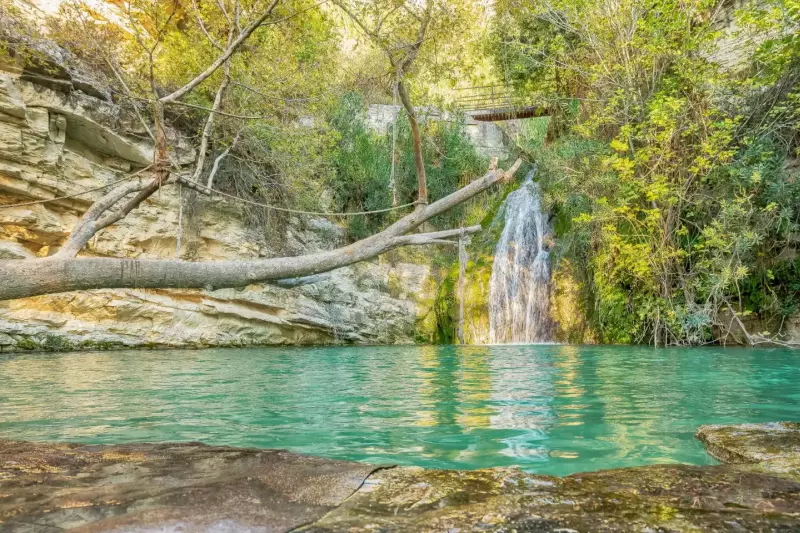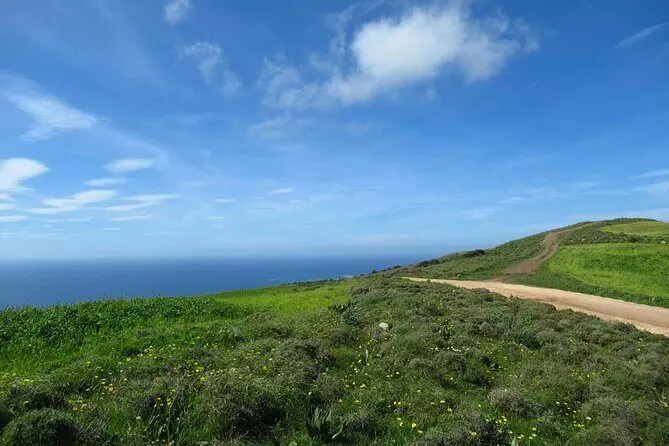
Tucked into the hills above Paphos, roughly 12 km from the city centre and just 2 km from the quiet village of Koili, the Adonis Waterfalls (also known as the Adonis Baths) are one of the few places in Cyprus where you can swim beneath a real waterfall. It is not a public beauty spot — the falls sit on privately owned land that has been turned into a small theme park, with an entry ticket, mythology statues and a natural plunge pool that stays refreshingly cold even in August. The drive out there is half the adventure, and the route takes you past some of the prettiest villages and viewpoints west of Paphos.
The 10 best accommodations in Tala, Cyprus
Here is everything you need to know before you go: how to get there, what to see on the way, and the rather remarkable legend attached to the water.
Why Visit the Adonis Waterfalls?
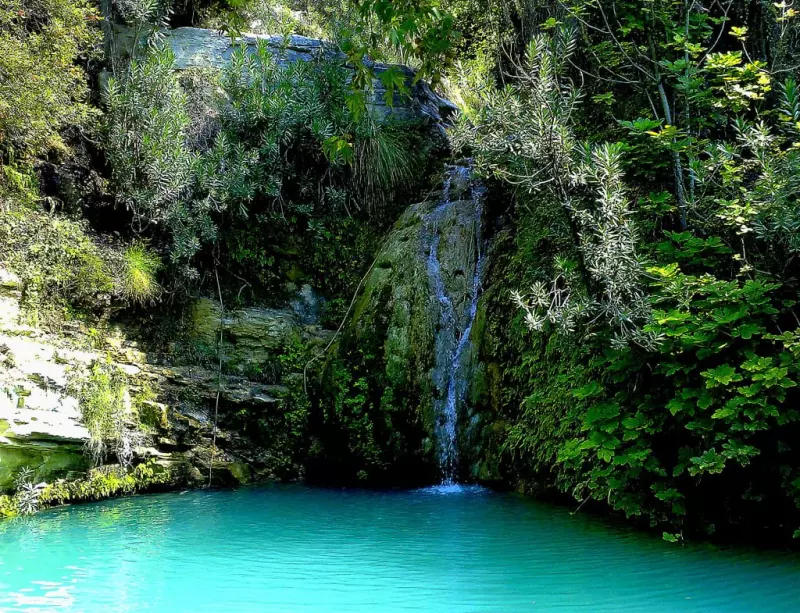
The falls are formed where water flowing down from the Mavrokolymbos area gathers into a small canyon and drops into a natural lake. Around it, the owners have created a park of Greek mythology statues, a historic water mill you can walk through, and nature trails along the gorge.
The big draw is swimming. The pool below the waterfall is deep, shaded by trees and dramatically cooler than the sea in high summer. According to local legend, swimming here has very specific benefits: men who bathe in the pool supposedly gain strength and virility, while women emerge with eternal youth. Touching the statue of Aphrodite and Adonis at the water’s edge is said to bring fertility — which, legend has it, is why Adonis and Aphrodite had so many children here. The people of Paphos like to say they are all descendants of those two lovers.
Even if mythology is not your thing, the falls are one of the most photogenic spots in the Paphos district, and one of the few inland places where you can genuinely cool off. If you are building a list of things to do in Paphos, this belongs on it.
Where Exactly Are the Adonis Waterfalls?
The falls sit on the north-western edge of Koili (Kili) village, in the hills between Tala, Pegeia and the Akamas hinterland. The site is roughly 12 km from Paphos city, about 7 km from Mavrokolymbos Dam, and can be approached either from Tala or from the Coral Bay / Akoursos side.
One important warning: Google Maps has historically shown the wrong route. The site’s own instructions tell visitors not to rely on GPS and to follow the “Adonis Baths” signs from Tala village or Coral Bay instead. Look for signs reading “Adonis Baths Water Falls” — they are frequent and clear once you are on the right road.
How to Get to the Adonis Waterfalls
By Car via Tala Village (the smoother approach)
From Paphos, take the B7 towards Tala. Drive through Tala village and keep following the brown signs for Adonis Baths. The Tala route is generally considered the easier of the two approaches, and it is the road the site recommends for bicycles and motorbikes. Allow about 30 minutes from central Paphos.
By Car via Coral Bay and Pegeia
The alternative is to turn off the Coral Bay road towards Kamares and Akoursos and follow the signs inland. This route strings together Coral Bay, the Pegeia sea caves and the hills above the coast — arguably the more scenic drive, and the one most quad-bike and buggy safaris take.
About That “Road Good for All Cars” Sign
The last stretch — roughly the final 2–3 km from the tarmac, depending on the route — is an unpaved dirt track: rocky, rutted in places, and narrow with occasional steep drops. The signs along the way claim the road is “good for all cars”, and plenty of visitors do make it in an ordinary hire car by crawling along at walking pace (budget 10–15 minutes for the dirt section). But many recent visitor reviews disagree with the sign, and there are two practical cautions:
- Many rental agreements exclude damage on unpaved roads — check your policy before setting off. If you scrape the underside of a rental on this track, that is likely coming out of your deposit.
- There are two car parks: a lower one for regular cars and a closer one for 4x4s. If the track looks too rough, park at the bottom and walk the remaining distance — it is a pleasant canyon stroll.
If you are not comfortable with the track, the popular alternatives are a quad bike, a buggy, or a jeep safari tour, which combine the falls with the sea caves, Edro III shipwreck and other Akamas-area highlights. You can compare options on our Paphos experiences page, and if you are still sorting out wheels, see our guide to car rentals in Paphos.
By Public Transport
It is possible but not exactly easy. Local buses (the 614 towards Koili, among others) will drop you in Koili village, from where it is roughly a 2 km walk to the site — the final section on the same dirt road. Realistically, this is a 30–40 minute walk each way, partly in full sun in summer. Fine in spring, punishing at midday in August.
By Taxi
A taxi or Bolt from Paphos Harbour takes around 20 minutes, but be aware some drivers are reluctant to take the dirt road in a regular saloon car — ask before you book, and arrange a pickup time since there is no taxi rank at the falls.
What to See Along the Road
The drive to the falls is a genuine half-day out on its own. Depending on your route, these are the stops worth making:
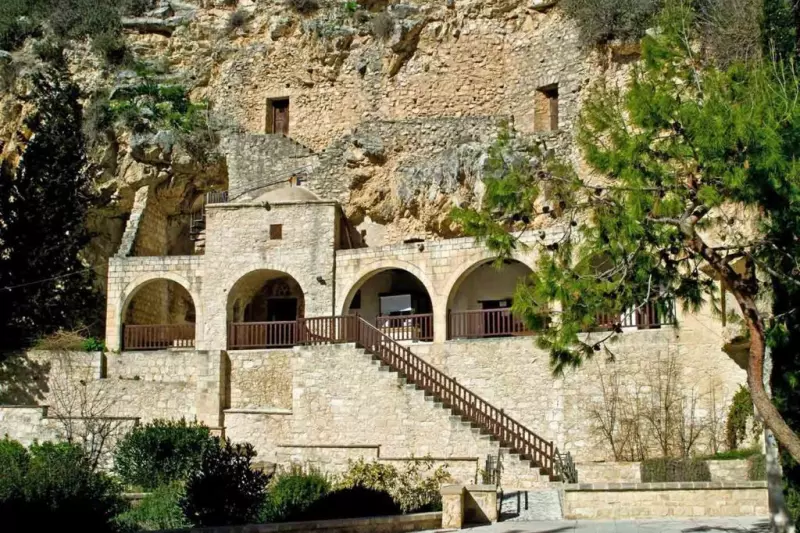
Agios Neophytos Monastery (Tala). Just above Tala village sits one of Cyprus’s most important monasteries, founded by the hermit Neophytos in the 12th century. The rock-cut Encleistra (the hermit’s own cell) with its Byzantine frescoes is the highlight, and the view over the Paphos coastline from up here is superb. It is the single best stop on the Tala route.
Tala village. A low-key hillside village with a pretty square and tavernas — a good coffee stop before the dirt road. Cat lovers should keep an eye out for the well-known cat sanctuary on the edge of the village.
Coral Bay. If you take the Pegeia route, you pass right by the most famous beach in the Paphos area, with its deep bay and facilities. Our guide to the best beaches in Paphos has the full picture.
Pegeia sea caves and the Edro III shipwreck. Just past Coral Bay, the coastline turns into low cliffs riddled with sea caves, with the rusty hull of the Edro III — a cargo ship that ran aground in 2011 — resting in the shallows. One of the most photographed spots in the district, five minutes from your route.
Mavrokolymbos Dam. On the Akoursos/Koili side, the road crosses country around this earth dam. In spring the hillsides around it are green and dotted with wildflowers; the canyon below it is actually what feeds the falls.
If you would rather see the wild Akamas coast without the dirt-road driving, the Blue Lagoon boat trips from Paphos cover that side of the peninsula by sea.
What to Expect at the Adonis Waterfalls
- Opening hours: Open every day, year round. Roughly 9:00–20:00 in summer, 9:00–18:30 in September–October, and 9:00–17:00 in winter. Hours can shift between seasons, so check the site’s official page before setting out.
- Entry fee: At the time of writing, around €15 for adults and €10 for children, paid at the small kiosk, which is advertised as cash only — bring euros to be safe. (Fees have risen over the years, so treat these as approximate and verify before you go.)
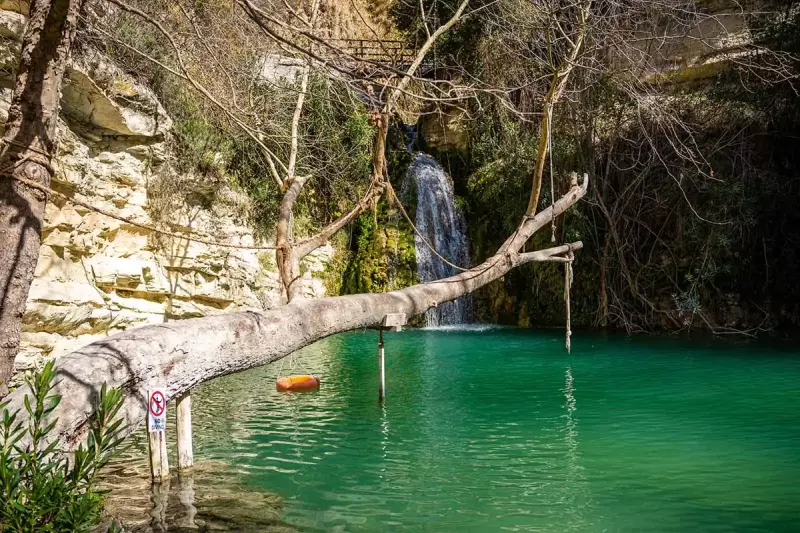
- The waterfall and pool: The falls drop into a deep, cold natural pool. A rope swing over the water is usually rigged up in summer. The rocks around the pool are extremely slippery — water shoes are strongly recommended.
- Statues and the water mill: The park is dotted with statues of Adonis, Aphrodite and other gods (some displays are more themed than natural, so manage expectations). The old water mill at the entrance houses a small museum of local memorabilia.
- Nature trails: Short paths follow the gorge up- and downstream from the pool, through fig trees and bamboo.
- Food and drink: A small on-site café serves drinks and simple food. The pool area has toilets and changing space.
Tips for Visiting
- Go early. Arrive around opening time (9:00) and you may have the pool to yourself; by midday in high season, tours and safaris arrive in waves.
- Wear proper shoes. The path down to the pool and the rocks themselves are slick. Flip-flops are how most visitors end up with a bruised tailbone.
- Bring cash. The entry kiosk does not reliably take cards.
- Do not drink the water — swimming yes, drinking no.
- Watch your step near the edges. The canyon walls drop steeply and there are no safety barriers.
- Best months: April–June and September–October, when the falls still have a good flow and the walk is not furnace-hot. Our guide to the best time to visit Paphos has the full seasonal breakdown. Note that after a dry winter the waterfall can slow to a trickle by late summer — the pool is always there, but the “waterfall” photos are best in spring.
Combine the Falls With a Bigger Day Out
The falls sit conveniently close to several other Paphos district highlights, which makes them perfect for a loop:
- Morning: Adonis Waterfalls via Tala or Coral Bay.
- Afternoon: The dramatic Avakas Gorge, one of the most spectacular walks in Cyprus, just south of the same Pegeia hills — stop at the famously quirky Viklari “Last Castle” restaurant at the gorge entrance for slow-cooked goat.
- Alternative loop: Falls in the morning, then back down to the coast for an afternoon at Kato Paphos and the Archaeological Park.
For more ideas, see our complete guide to day trips from Paphos — the falls and Avakas Gorge together make one of the best half-day trips from the city.
FAQ: Adonis Waterfalls Paphos
Is the road to the Adonis Waterfalls suitable for a normal hire car?
Roughly the last 2–3 km are an unpaved track. Many visitors do drive it slowly in ordinary cars, but many rental agreements exclude unpaved roads — check your policy first. The site is easier to reach by quad, buggy or 4×4. Alternatively, park at the lower car park and walk.
How much does it cost to visit the Adonis Waterfalls?
Around €15 for adults and €10 for children at the time of writing, advertised as cash only — bring euros. Prices have changed over the years, so check before visiting.
Can you swim at the Adonis Waterfalls?
Yes — swimming in the natural pool beneath the falls is the main attraction, and legend says it grants men strength and women eternal youth. The water is cold and the rocks are slippery, so bring water shoes.
How do I get to the Adonis Waterfalls by public transport?
Take the bus towards Koili (Kili) village, then walk roughly 2 km along the dirt road to the site — about 30–40 minutes on foot. Most visitors find a car, quad or tour far more practical.
Are the Adonis Baths and the Baths of Aphrodite the same place?
No. The Baths of Aphrodite are a small grotto on the north coast of the Akamas near Latchi, while the Adonis Baths/Waterfalls are inland near Koili village, close to Paphos. Same love story, different swimming hole.
What is the best time of year to visit?
Spring (April–June) for a strong waterfall and green hills, or September–October for warm water and thinner crowds. Late summer can reduce the falls to a trickle.